Showing posts with label sewing. Show all posts

Wednesday, 5 November 2014

Coat of arms - The secret of our ancestors


The coat of arms is a unique heraldic design on a shield, which was originally used by medieval knights to cover, protect and indentify the wearer. The design became a unique symbol to an individual person or family.

I found myself searching for clues of my family name in the internet. There are lots of websites that provide information on the origin of your family name. More information can be purchased together with little souvenirs or a print out of the family history. I don't know how reliable those websites are but they information provided looks intriguing.


Since I started watching the TV programmes "Who do you think you are?" and "Finding your Roots", I am curious to find out more about my ancestors. Both series investigate the family history of their famous guests with traditional genealogical research, though the series "Finding your roots" also uses genetic research to determine hidden cultural origin.

It's not about the life of people, who found their way into History books. It's about the people, whose stories have been forgotten, but who achieved incredible by trying to survive - History becomes all of a sudden very vivid and personal.

A story that impressed me very much is the family history of British actor David Sachet, shown in the 5th series of the British version of "Who do you think you are?". He discovers that his paternal ancestors were actually Russian Jews. Due to imminent persecution, they had to flee Russia over the Turkish border. From there they had to travel via Prussia, South Africa and France, to finally arrive to the UK, where they were able to settle down. During this journey they had to change their names a few times to hide their Jewish origin, which finally resulted in the French sounding surname "Sachet".

I need to make my project one day and search on websites like ancestry.com or myheritage.com for more information on my family tree. Those websites have access to an online database where billions of historical records worldwide (birth, marriage, death, census, military and immigration records) are uploaded, which makes it comparatively easy to trace family history. 


For now, I made it my project to sew a family banner with the coat of arms of my boyfriend's surname.

I was searching for clues on mine and Steve's surnames, when I found to my surprise an entry on his surname on Wikipedia. His name has apparently Irish origin and is closely connected to the history of Ulster. To have a Wikipedia entry on your family name is really cool, so I had to honour it by sewing a banner with his coat of arms.

Here is a list of what the symbols could refer to:
The Lion represents a great Warrior or Chief.
The open red hand is a symbol of the Province of Ulster.
The crecent is the hop of glory or the sign of the second son.
Red is the colour of a Warrior and symbolises Military Strengh.


There were two things in the process of crafting the banner, which were new to me.

First one is a technique in embroidery called couching, in which yarn or other material is laid across a fabric material and is fastened in place with small stitches of the same or a different yarn.
I used this technique to frame the banner with a grey woollen threat, which would contrast the white ground fabric and the ruby coloured motives.


The second technique was making a tassel. It's a lovely creative ornament which is similar to the making of a pom-pom. If you are interested to know more about the how-to, here is a link to a YouTube video tutorial.  

I hope this little excursion to history was inspiring and maybe make you want to learn more about your ancestors and family tree, too.

Sunday, 11 May 2014

What has a rainbow drop got to do with Gabrielle Roth?


I guess it's nothing really, but finding a headline that covers both of my topics of the day is not that easy. If you have any better ideas or suggestions, leave a comment! 

A few weeks ago, I discovered that the dancer and musician Gabrielle Roth, who created the 5 Rhythms in the early seventies, passed away in October 2012. That made me remember her dance seminar of which I was present for in Hamburg, in 2002 with her son Jonathan Horan.
The seminar started on a Friday afternoon and ended on Sunday evening. My friend Anne, I and some fifty other people danced through the whole weekend. No judgement of dance moves just the freedom of expression through my body and the bliss of forgetting myself in the rhythm of the music. 

Gabrielle Roth dreamt of becoming a dancer since she was a small child, but the experience of going to a catholic school where the nuns condemned the body as a source of pleasure and the experience of a strict ballet teacher who punished her for every wrong move, made her abandon her dream when she grew older.

Eventually, she became a masseuse in the retreat centre Esalen, which focuses upon humanistic alternative education like psychology, meditation, yoga and spirituality. One day, Fritz Pearls asked her to teach movement classes. She was surpised to discover how many of  her students were stiff in their motoric, afraid of letting their body move freely. In an exercise she asked the participants of the class to lie on the floor and to shake their hips.This simple but challenging excercise released surpressed emotions in a lot of the participants who had to start sobbing. 

Gabrielle discovered there, that the body can't lie; "put into motion, and the truth kicks in".
She realized that emotions, which have been denied, are trapped in the memory of our body. By bringing the body parts into motion, different emotions can emerge and confront us with the neglected truth of our body. All she wanted from this time on, was to "seduce people back into their body". 

Over time she created the 5 Rhythms which are connected to our emotional landscape:
Flowing - Fear
Staccato - Anger
Chaos - Sadness
Lyrical - Joy
Stillness - Compassion

All together are called a "wave". Dancing through the wave can help us to re-connect us with our soul. 
We dance through the different emotions until we come to rest in stillness. Like in meditation, we focus on our breath and our heartbeat. 

The 5 Rhythms are a powerful exercise. Although there are a lot of trained 5 Rhythms teacher everywhere in the world, there is a easy exercise that you can do at home and which can teach you to free your body. 

In the book series of the "Peaceful warrior" by Dan Millman, the writer suggests 25 very basic and easy to follow fitness exercises. Like in Yoga, he points out the benefits they have on our emotional and energetic body. One exercise is called "free motion" and he recommends doing at least this exercise daily if you don't have time for the other.

The instructions are the following:
- Take at least 30 seconds for this exercise
- Let your body flow in a continous motion
- Be relaxed, aware and breath deeply
- Move in different level of height: close to the ground, stretch to the side, stand on your tip toes.
- Move without thinking or planning what to do next. Try new movements, vary them.

This exercise is supposed to strenghen creativity, spontaneity, grace and confidence. I try to include every part of my body during this exercise. In autogenic training you have to move your consciousness from one body part to another (e.g. hips, thighs, lower leg, ankles, foot and toes) in order to relax, I try to do the same, but instead I try to include them into the motion (roll my neck, bend my back, stretch my arms).

Now, to something totally different. In case you were wondering, what I was up to the past weeks: voilà!


The name for this crafty project is called Rainbow drop. I am always amazed how sunlight and rain can create something as beautiful as a rainbow.

The explanation of the phenomenon: the rainbow is caused by light being bent when entering a droplet of water, then reflected inside on the back of the droplet and refracted again when leaving it. The observer sees the layer of reflecting water droplets in front of him (with the sun in his back). All rainbows are full circles, however, the average observer on the ground sees only approximately the upper half of the arc.
The rainbow has always had an interesting role in our culture (e.g. religion or mythology) and is used as a symbol in our society (e.g. peace symbol).

My idea for this project was not to simply do a cloud mobile but to reference the magical aspect of the sunlight, which can create a rainbow with the sparkling sequins on the frame and the rainbow drops
I choose not to use the spectrum colours of a rainbow (red, orange, yellow, green, blue, indigo, violet), but to choose a colour palette (pink, orange, yellow, mint, turquoise) that has a bright and cheerful character.


The Cloud is made of wire (pipe cleaner wrapped around it to enforce the frame). I cut grey felt into long stripes and sew them together with the sewing machine, winding it around the carcase. I then sewed the sequins onto the felt with a transparent plastic thread.


The raindrops were an easy project compared to the cloud frame. After cutting the rainbow drop shapes out of the felt, I decorated them with colour matching sequins. I sewed the matching felt sides together and stuffed it with a bit of wadding before sealing the loophole.

The tricky part was to arrange to drops, that they would hang evenly in one line. It is definitely easier if you have the mobile lying on the floor, and knot the thread to the raindrops first. Like that you can rectify with the length of the thread before tying it to the cloud frame.


Something I am really chuffed about is the winner of the Eurovision Contest 2014: Conchita Wurst, I just love her!

I would love to fight for the right to grow a beard, but some things in life are just unfair ;-)

Thursday, 20 March 2014

Starting Spring with a colourful Boho clutch


Spring is in the air. We had some wonderful mild weeks here in Newcastle with lovely sunshine. I enjoyed the weather by sitting on my little bench in the garden and embroidering this new project of mine: a felt clutch.
When I started with the idea, I thought it would take only a few days to finish, but with the pattern for the inlay and the embroidery design it actually took 4 weeks.

More about the clutch in a few moments as I apologize to interrupt this program to bring you an important news flash.

Steve and I signed up for the Great North Run on the 7th of September. It is the second largest half marathon (13.1 miles) in the world. It starts in Newcastle and finishes in South Shields.
I know it sounds crazy when you think of the long distance, but I am really looking forward to this event! I already started training every week and will increase towards summer with longer routes.

We will run raising sponsorship money for the Mind Charity. Mind is the leading mental health charity in England and Wales to supports people who struggle with their mental health. Their service includes supported housing, crisis helplines, drop-in centres, employment and training schemes, counselling and befriending.

It is important to raise the awareness for mental health problems as there are many prejudices against it in our society. Every year, one in four will experience a mental health problem, it is vital that we have an open public discussion on mental health issues, so that no one concerned has to be ashamed asking for help.

I will write more about the Great North Run and on the Mind Charity, as the events get closer. As I am fundraising, any donation how small is much appreciated. Please find my fundraising account here.
Please note that already a donation of £8.70 can support the Mind Infoline team taking a call to someone in desperate need.

Back to a less serious subject.

I have discovered a new passion besides sewing soft toys: sewing Clutches!


When browsing on Pinterest, I discovered so many awesome DIY clutches of fellow bloggers, that I felt inspired to have a go myself.
At her last visit, my mother brought me some 100% pure wool felt in a Natural Beige colour from Germany as a present, knowing my high demand on crafting material.

The natural felt reminded me of traditional Bavarian folk design, and so I decided to mix up a folkloristic design from Hungary and Scandinavia with bright colours. The result was a boho chic clutch. 


To clarify the term Boho chic -

Boho chic is inspired by bohemian and hippie influences. In modern usage, the term "Bohemian" is applied to people who live unconventional, usually artistic, lives. The original "Bohemians" were actually travellers or refugees from central Europe (hence, the French bohémien, for "gypsy").

The romantic perception of Gypsy culture includes free-spirited living and travelling, colourful fabric and cloths, jingling jewellery, the magic of tarot and palm reading, cheerful music and liberating dancing.

I would like to pick up the gipsy theme at a different time and working with vintage thrift to create decoration, toys and clothes. The Blog Dottie Angel is a great source for vintage inspired crafting.  


Every learning curve comes with its trials and errors.
Although the design of the clutch seems to be quite easy and straight forward, coming up with the pattern wasn’t.
Next time I will keep in mind to make the lid smaller than the body of the clutch.
And another flaw, I sewed the little pockets to the wrong side, namely to the front/inside.

But I do love my little gem anyway. I can’t wait to try it out on the staff night out on Sunday.


Wednesday, 19 February 2014

Filou, the flounder


I can re-assure you, Filou is still alive. I haven't eaten him, I promise!

How it all started: I love flicking through the cooking books of Hugh Fearnley Whittingstall. Not because I'm looking for recipes (you know that cooking is not my favourite past time, although eating is), but rather to enjoy the lovely illustrations. I particularly like the book "Hugh's Three Good Things", which has previously inspired my vegetable bunting

I have to write a little bit more about Hugh Fearnley Whittingstall as he is such an inspiring person. In 1999, the London journalist moved to the countryside of Dorset, to film a TV show about how he dealt with becoming a self sufficient small holder in the series "Escape to River Cottage".

 Along the way he shows how he deals with occuring problems due to his own inexpericence, gives insight in country life and  introduces the local farmers.

As the TV Series becomes more popular, he started expanding his adventures - included fishing, foraging, going on mushroom forray, seasonal farming, chicking holding, cheese making, bread baking, preserving, home brewing and much more. Besides his cooking books he has another more specific series of books "River Cottage Handbook No.1-10", in which he lets specialists detail about their own area of expertise (e.g. bread baking, brewing). 

He now supports many campaigns, like Hugh's Fish Fight (saving certain areas in the sea for fish population recovery. By the way, Tim Mälzer is a huge supporter of this campaign in Germany), Chicken-out Campaign (to stop chicken from being reared in cages for egg production or fatting them to sell the meat), the Land Share Project (to re-purpose unused land for allotments) and much more.

I respect Hugh as he is a man of simplicity who likes to share his gifts with others, is happy to trade knowledge and talent, he enjoys engaging with the community and promotes healthy living, and all in all he's very down-to-earth. It always inspires me to see what a single person can do to help others.  

Coming back to where I started ... I saw the quirky drawing of a flatfish in one of Hugh's cooking books, and so I decided to sew one just for the fun of it. 


I finally got round to using the embroidery foot of my sewing machine to embroider the felt patches and to create the textured scaling of the fish. Unintentionally, the embroidered scales created bubbles, which although probably wrong, I think looks great.

Another premier was the "quilting" of the fins and tail of the flounder. I stuffed the pre-sewed fabric with wadding and embroidered it with a wave like pattern.


I used up nearly all of my fluorescent NEON thread which I bought at Lidl, so I was very happy when I discovered, that Hobby Craft now finally stocks the NEON thread from Gütermann. I could stare for hours at my new NEON threads, my little gems.


What do you think of the new NEON threads from Gütermann and for what sewing project would you like to use them for?

Monday, 20 January 2014

Once upon a time


The past weeks have been interesting for me. I've joined "The Big Blogging Bootcamp" with Elizabeth Sellers - her blog Rosalilium - in the beginning of January. Besides learning a lot of new stuff and being able to ask questions. It's great to meet some many other keen bloggers who are interested to share and to exchange experiences. 


Another change to come is my new part time job, which will hopefully give me spare time again to follow up creative ideas on sewing and crafting.
I received some great Christmas presents: a light box (inclusive daylight lamps and a tripod) and a graphics tablet. Maybe you notice that I'm trying to figure out how the light box works for taking photos. The graphics tablet is a more complex thing to discover, but it essentially works like drawing with pens. The difficult part is to figure out all the functions on the drawing program, like the freeware GIMP. 

The following months, I would like to write more about the book "The Artist's Way" by Julia Cameron.The book is actually a 12 week course in discovering and recovering your creative self, consisting of a weekly task list and weekly essays. Additionally you have to write a morning journal and go regularly on an artist date to fill your creative source. I read the book when I was twenty years old, recommended by a creative friend who got the book recommended by a creative friend and so on. Since that time the book proved itself to be a great support on various occasions, like a good friend who whispers words of encouragement in your ear when you need it.
* You can find now a complete online course on Julia Cameron's website, have a look.

Have you had a book in your life that inspired you and changed your creative life? Have you read "The Artist's Way" yourself and what are your experiences with it?

Friday, 8 November 2013

Creative people: Berlin based artist Vanessa


In today's post I would like to introduce you to the artist and friend Vanessa Puschmann, and show you some of her work - which always inspired me. 

Vanessa is a mixed media artist, working and living in Berlin. I met her when studying Art Therapy in Bremen, Germany. She left after a few terms to study cultural science, but we stayed friends.

With her background as a dressmaker and her theatre experience, she connected with the art scene in Bremen on various quirky projects:

“Sproutbau” (2007)
For one month about 70 international artists lived and worked together in a high-rise block, which was planned to be destroyed. 
Vanessa, as a part of the textile studio, and other artists worked towards a final festival week, to present exhibitions, readings, performances and concerts. 

“EphmerisKosMusTanten” (2008)
For one month artists installed a fictional temporary state "Ephmeristan" in an industrial building area. Different artists worked on various projects and prepared for events for the festivals final weekend. 
Vanessa was part of the fashion performance "EphmerisKosMusTanten", which was a collaboration project of 6 fashion designers, a make-up  artist and some experimental performers. She designed the costumes and also performed on stage.

After finishing her studies, Vanessa decided to move to Berlin. She quickly connected with the art scene and frequently participates in exhibitions and cultural events. 
As a mixed media artist she uses paintings, textile art and performance to explore questions of identity, physicality, spirituality and society. She works as a solo artist and also on collaboration projects.

Here are two recent projects of hers, which inspire my work.

"Kiezkinder" (2010)
Vanessa used old fabric, old clothes and every day materials to tell the stories of some characters of Berlin. Please find below some of her art puppets "Kiezkinder" (Children from the Berlin district Kiez).


http://vanessapuschmann.de/portfolio/kiezkinder-2


“Djangos fahrende Flickwerkstatt” (2012)
Textile artist Vanessa, photographer Effrosynio Kontogeorgou and writer Dorothea Ahlemeyer set of to Eastern Europe. With the medium of the puppet Django, they visited the Czech Republic, Slovakia, Hungary, Bosnia and Croatia, and engaged with people on questions of happiness, sorrow, hope. Due to interaction with these people new puppets were created with found fabric and materials. The result was a patchwork of stories, pictures and experience, which is documented in an art book.
(Winner of the competition "kultur-im-dialog.moe 2012" - a programme of the Schering Foundation and the association MitOst e.V.)


Grrrgz wants to go home…


I had a opurtunity to interview Vanessa this week about her work and future projects, which you can read below:

What do puppets mean for you as an art medium?
I love to think about identity and to create them. The puppets are one possibility to do this. And I can create what I want. I love it, when they look like real personalities, when you feel them. 
The thing with the puppets grew out of a birthday present for a friend. I did it with another friend of mine. I liked to do it and tried more and then more ideas came, e.g. using text to describe their character and it was a feast to do, and to see what happens with the different puppets.

Did you depict typical Berlin inhabitants?
Some of them YES. "Kalle Straßenfuchs" (I created him together with my boyfriend) is one who lived all of his life on the streets of Berlin. He had so many adventures in his life but also some accidents, you can see the wounds on his body. He lost the half of his tail in fight with a car... So yes, you can find them on the streets. In Berlin you see lots of different characters. I really like it! Of course I'm inspired by this diversity. My puppets are mostly inspired by people of the districts of Kreuzberg, Neukölln and Friedrichshain.

Can you tell me more about the puppets which were created on "Django's Journey"?
The puppets are made of old fabrics and stuff from people who gave it to me as a present. The puppets Lamella and Ludmilla were part of an art and culture project in 2012 "Djangos Journey". The idea was to meet people around the Balkans, talk to them, listen to their stories, get some personal stuff from them and create a puppet out of the people we met. So every place has a character with its own identity, including every story, every person we met and of course my interpretation and artistic view.
As a frame to our trip we had the story of puppet Django, he is an adventurer and loves to travel! I created him in 2011 as a present for my friend Doro, after a while he inspired us to this project. Ludmilla was made in Bratislava. She was the fourth puppet. And she looks like a traditional woman. Lamella was the last one, I made her together with Grrrrgs. For me both were the hardest puppets to create. It was at the end of the trip and I was full of stories and experiences. It was hot and I was really tired. I had real problems, but when they were born, I was so happy! I loved them. I had the feeling, Grrrrgs was my first child.

Where do you find the materials to create the puppets and will your future work include puppets as an art medium?
I use old stuff, old fabrics, plastic... different things with their own histories. People give things to me or I find them on the streets or somewhere else. The material inspires me. My newest puppet, called "Alienfounding", is made out of an old dress I made, and I think it started a new way of creating puppets for me. The dress (which I loved) was made of white wool with a hood. After a time I decided to dye it brown. Unfortunately I forgot it was wollen and after I washed it, it shrunk to a child size - Shit. So I cried and thought about what to do... and the idea of the puppet came to me. It's a tribute to my old dress. 
The new thing is, that it's bigger and not so cute - it's more spooky. I began taking photos of it and I think, I will go in new ways directions from here. Perhaps I will do take more photos or make a small film - I'm not sure yet, but I'm positive that the ideas will come to me!

If you want to know more about her work, please check out her website and Facebook page:

Vanessa's website

Vanessa's Facebook page

Tuesday, 5 November 2013

Please welcome to the stage: Carl Confetti


Well, it isn't quite Easter yet, but I felt like I had to do something colourful, and it had to be a rabbit.
I wanted a design that would remind me of the computer game "Raving Rabbids", where the rabbits are look like a kid has drawn them.


I like design that looks unfinished, clumsy - it has a certain charm (and that's not my excuse for not having mastered the sewing machine yet.) One of my new year's resolutions (they have come early this year) is to particpate in a sewing class to discover more options, tricks and tips of the trade. 
Allow me to briefly introduce Carl Confetti. 
Carl loves the circus, and that's where he wants to learn how to roar like a lion. He is under tuition from Cato, the Lion, but his rabbit voice is rather squeaky. 
Unfortunatley Carl has never visited a circus before, because he is terribly afraid of clowns. They scare him with their curly wigs and their big smiles. 


The tulle pompoms were easy crafted. Instead of using a long woollen thread, I used a ribbon of tulle. One can cut along the tulle - 1m long and 10cm wide. Then pick the tull, so it becomes more voluminous. 


I have a slight affection for confetti patterns (see the Felefant).

Does anyone else have a love of confetti or polka dot patterns, if so; have you produced something similar that you would like to share?

Sunday, 13 October 2013

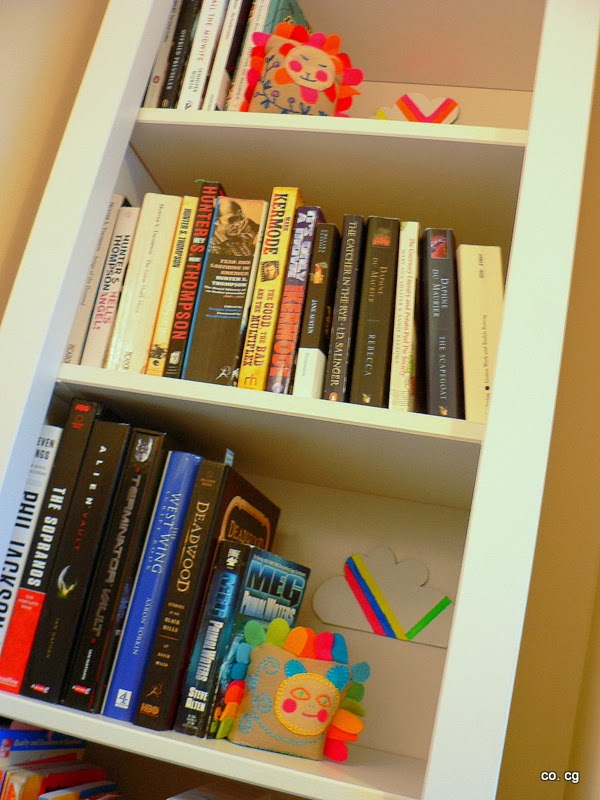
Bookshelf Elves - Berry and Blue


The bookshelf elves are related to the Pebbles, but different from them, they love to live in bookshelves, preferably next to their favourite book.
Berry prefers the classics more, Blue is more into films, and therefore likes geeky film books.
Sometimes it takes a long time until a book is finally chosen from the shelf to be read. The elves keep the books happy and entertained in the time when nothing exciting happens. 


Once when I was visiting my mother during a university semester, I had the idea when looking at her huge bookshelf to organize the books by colour. It took my mother actually two months to realize what I'd done. Although she didn't share my taste in colour composition, we both had a giggle about my strange humour. 


The bookshelf elves are filled with rice, so they have some weight, sometimes enough to work as bookends.
They also make a nice decoration for bookshelves, to give them a bit of life, between those dusty treasures. 


Blue was my first bookshelf elf. Although I'm normally not too keen in rainbow colour palettes, I choose the palette, as I thought it makes a beautiful frame of scales.


This time I wanted to try the blanket stitch, which I had seen on a tutorial on The Pearl Bee blog. The embroidery is made with pearl cotton.  I don’t know if it worked out well, but it’s something different.


When designing Berry, I was thinking of the 60's colour palette - of orange/red/pink. I decided to use blue for the embroidery to give it some contrast.

Do you choose a colour palette before starting a new project or do you decide in the process of making what looks good and what doesn’t?
Google Analytics Alternative